How to Get Rid of Static Hair: Quick Fixes and Winter Prevention

If your hair crackles when you pull off a hat or clings to your scarf, here is how to get rid of static hair fast, and how to stop it coming back. Heated rooms are dry, hats and scarves add friction, and this year Hampton Roads expects a damp, rainy winter outside. Below: quick fixes, the habits that prevent static all season, tips for textured hair, and when a salon treatment helps.
Quick answer: how to get rid of static hair fast
- Pass an unscented dryer sheet lightly over the flyaways.
- Mist anti-static spray or hairspray on your brush, not your head, and brush through.
- Rub a little hand cream between your palms and smooth it over the static.
- Run damp fingertips along your hairline and ends.
- Finish with a light leave-in conditioner.
These come from Glamour and Healthline, detailed below. The long-term fix is moisture. As NYC salon owner Oscar Blandi told Glamour, "Very simply put, static flyaways happen when the hair or the environment around the hair is dry, so moisture is the answer."
Why is my hair static? What causes static in hair
Hair builds up an electrical charge like the rest of your body. Healthline explains that when you wear a hat, electrons can build up on it and leave with it when you take it off. Your strands are left with the same charge, so they push away from each other, "just like magnets."
Dry air makes it worse. The Cleveland Clinic says static happens "when moisture can't penetrate your hair strands," because winter air is much drier and products can build up on the hair. When the air is that dry, the charge stays on your hair after the hat comes off. Indoors, the clinic adds in a separate article, furnaces pump homes full of "hot, dry air."
Friction is the other trigger. Stylist Glenn Ellis told Allure that flat-ironing too much or working a round brush through the hair for too long puts a lot of friction on it, and that changes in humidity play a part too. Dry hair, a drier climate and friction build the charge, "hence why this is usually a winter concern," Allure notes.
Here in Virginia Beach, the winter outlook adds a twist. Jeff Orrock of the National Weather Service in Wakefield told WHRO that Hampton Roads may see "more days in which temperatures are in the 30s and 40s and rainy." Damp air outside and dry, heated air inside can mean frizz and static in the same week.
5 quick fixes for static hair right now
Use a dryer sheet
Glamour calls dryer sheets, "preferably the unscented kind," the gold standard for calming static. Pass one lightly over your hair; pressing hard can leave white residue. Healthline adds that you can run one over your brush or pillow.
Mist static guard or hairspray on your brush
Glamour's advice is not to spray it all over your head. Mist a little on your brush, then brush through; hairspray is a good second choice. Salon owner Jet Rhys also suggests spraying hats and scarves "inside and out."
Smooth on a little hand cream
Rub a small amount between your palms, not straight onto your hair, then smooth your hands over the flyaways (Glamour). Healthline suggests face moisturizer too.
Touch it with a little water
Blandi calls water "the easiest non-product way to fight static." Put a little warm water on your hands or a tissue and run it along your hairline or ends, wherever the flyaways are.
Add a light leave-in conditioner
Healthline lists a light leave-in conditioner as a way to moisturize strands and reduce flyaways. In Allure, Ellis also suggests a leave-in cream, hairspray or dry shampoo to weigh the hair down.
How to prevent static hair all winter
To prevent static, keep moisture in and friction down. These are the habits the sources agree on most:
| Habit | Why it helps | Source |
|---|---|---|
| Condition after every shampoo | Conditioner helps bind the hair fiber and, in winter, helps deter static | AAD; Cleveland Clinic |
| Add one more weekly deep-conditioning treatment | Conditioning products help hair hold moisture and weigh strands down | Glamour |
| Use a leave-in conditioner or a hot oil treatment | Both help fight the static that hats and dry, warm air cause | Cleveland Clinic |
| Swap a plastic brush or comb | Plastic tends to make static worse; see the note below on what to use instead | Glamour; Healthline; Byrdie; Allure |
| Choose cotton, silk or wool hats and scarves | Natural fibers do not hold a charge as well as nylon and polyester | Healthline |
| Wrap wet hair in a towel instead of rubbing it | Rubbing damages hair; a cotton T-shirt is another gentle option | AAD; Byrdie |
| Use heat protectant, the lowest heat setting, and hot tools once a week or less | High heat dries hair out, and dry hair is more prone to static | AAD; Byrdie |
| Run a humidifier at home | Keep indoor humidity between 30% and 50%, and do not overdo it | Cleveland Clinic |
Which brush? Glamour and Healthline suggest metal, Byrdie suggests wood, natural bristles or a wide-tooth comb, and a stylist in Allure prefers boar bristle. All agree on moving away from plastic. Healthline and Byrdie also suggest an ionic blow-dryer.
Wash with care. The American Academy of Dermatology suggests shampooing the scalp and letting the rinse flow through the lengths. How often to wash depends on how oily your scalp is (Cleveland Clinic), and a clarifying wash now and then helps if products build up.
Watch your scalp too. The Cleveland Clinic notes that the scalp also gets dry in winter and suggests keeping it moisturized with an oil or conditioner. If you notice changes in the texture or look of your hair, the AAD recommends seeing a board-certified dermatologist.
Static vs frizz in a Virginia Beach winter
Are static and frizz the same thing? No. Byrdie explains that static comes from two unlike things rubbing together, while frizz means the hair's cuticle is not smooth, which humidity or a curly texture can cause.
| Static | Frizz | |
|---|---|---|
| What you see | Strands lifting and pushing apart, clinging to hats and clothes | A puffy, rough texture |
| Main triggers | Dry air, heating, friction from hats, scarves and brushes | Humidity, rain, a cuticle that is not smooth |
| When it shows up here | Indoors, in heated rooms | Outdoors, on damp and rainy days |
| What helps most | Moisture and less friction | Moisture, and smoothing for frizz that lasts |
If your real problem is frizz that puffs up in the humidity, a keratin smoothing treatment in Virginia Beach is the option built for that. Our service page notes that clients report 4 to 5 months of smoother hair, and every treatment is quoted at a consultation. For more on the coastal side of the problem, read about humidity frizz and keratin smoothing.
Static hair tips for curly, coily and textured hair
Curls and coils need moisture most of all, and the American Academy of Dermatology's tips for Black hair focus on exactly that:
- Wash once a week or every other week, which helps prevent drying product build-up.
- Use conditioner every time you wash, and coat the ends, the oldest and most fragile part of the hair.
- Use a hot oil treatment twice a month for extra moisture and elasticity.
- Apply a heat protecting product to wet hair before styling.
- Comb textured or tightly curled hair while it is damp, with a wide-tooth comb (AAD).
Any texture can borrow from curly routines: Blandi told Glamour that wax-based products or oils for curly hair "are ideal since they are heavier and will weigh hair down."
Protective styles keep ends tucked away from scarves and collars. The AAD's rule is that braids and cornrows should never be too tight: "Pain equals damage." Our braids and protective styles start with a wash and scalp treatment and are braided firm enough to last, never tight enough to hurt. If you prefer to wear your hair smooth for the season, a Dominican blowout starts with a wash and deep conditioning and uses no chemical straightener.
Color-treated or blown-out hair
Two dermatologist tips matter more in winter:
- Space out chemical services. The AAD suggests stretching color, relaxer or perm touch-ups to every 8 to 10 weeks or longer when the air is dry.
- Go easy on heat. Use a heat protectant, the lowest heat setting, and hot tools once a week or less (AAD).
For keeping color glossy through the season, see our winter hair color ideas. For blowout care, including how long one lasts, read what a Dominican blowout is.
When a salon treatment helps
Most static is solved at home. A salon visit makes sense when your hair stays dry no matter what you do, or when frizz is the real issue.
- Deep conditioning. Every source above puts moisture first. At the studio, deep conditioning is a step in every Dominican blowout and is also available as an add-on with other services.
- Keratin smoothing. For frizz that puffs up in the humidity, not static as such. See keratin treatment.
- A trim. Our haircuts and styling page recommends a trim every 6 to 10 weeks for healthy hair, to take off split ends before they travel up the hair.
- A protective style. Braids keep ends tucked in through hat and scarf season.
Prices are not published on the site. Every service is quoted at a consultation, based on your hair's length, thickness and condition.
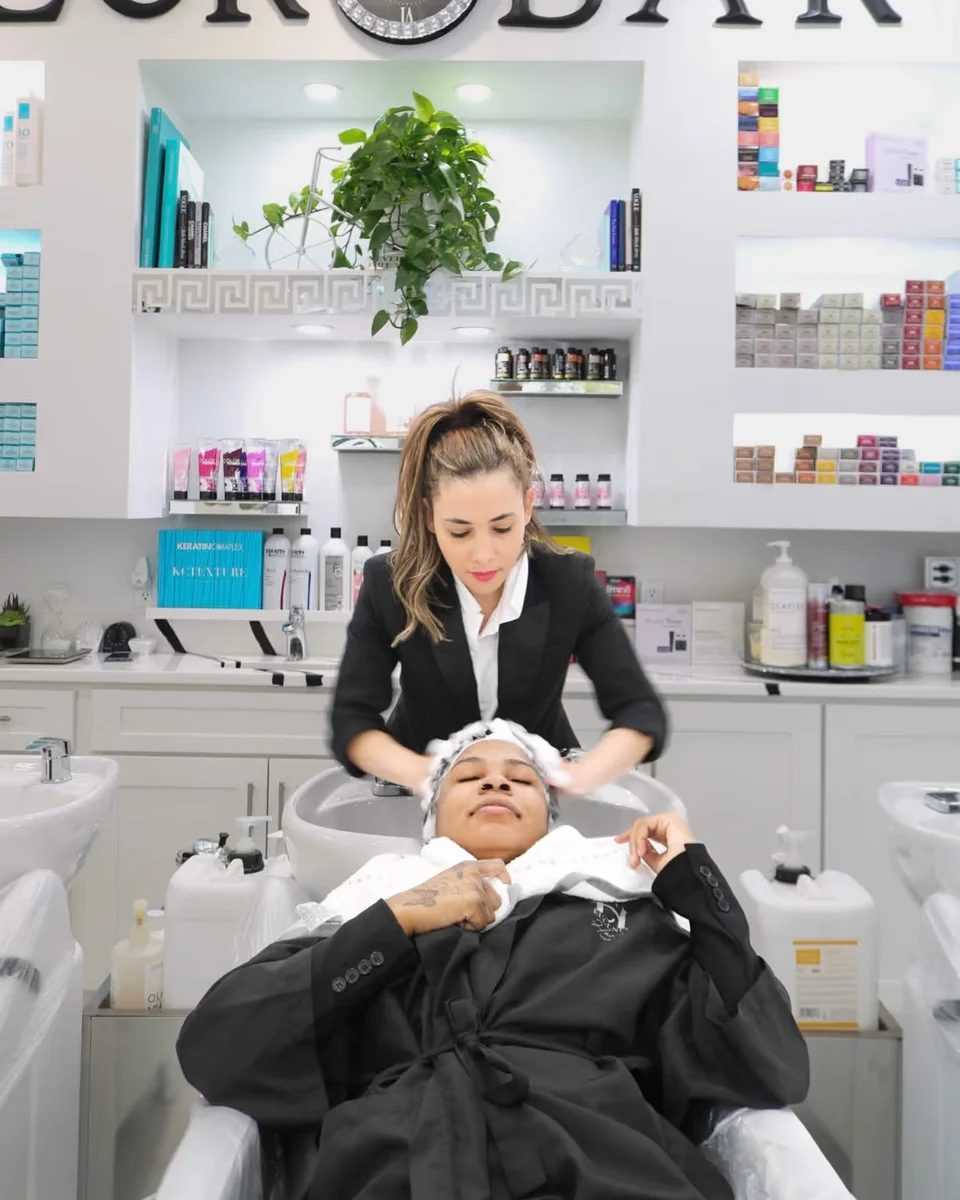
Get a moisture boost in Virginia Beach
Eugenia Hair Studio is at 4001 Virginia Beach Blvd, Suite 114, Virginia Beach, VA 23452. We offer Dominican blowouts with deep conditioning, keratin smoothing, braids and protective styles, and haircuts and styling. Appointments are required (no walk-ins). Hours are Monday 10 to 4, Tuesday to Thursday 10 to 6, Friday and Saturday 9:30 to 6, and Sunday closed. Se habla español.
- Book online
- Call or text 757-478-9908
- Meet Eugenia Drescher and the team, see our work in the gallery, or get directions and contact details.
The most common questions
How do you get rid of static hair fast?
Glamour and Healthline suggest an unscented dryer sheet, anti-static spray or hairspray misted on your brush, a little hand cream smoothed on from your palms, or damp fingertips along the flyaways.
Why is my hair so static all of a sudden?
Usually it is the season. The Cleveland Clinic explains that dry winter air keeps moisture from reaching the strands, and indoor heating makes the air drier. Hats, scarves and brushing add friction, which Allure says builds the charge.
How can I prevent static hair in winter?
Keep hair moisturized and cut down on friction. The AAD and Cleveland Clinic recommend conditioner after every shampoo, Healthline suggests cotton, silk or wool hats and scarves, and the Cleveland Clinic suggests a humidifier that keeps indoor humidity between 30% and 50%.
Do dryer sheets get rid of static in hair?
Yes, as a quick fix. Glamour recommends an unscented sheet passed lightly over the hair; pressing hard can leave residue.
Does conditioner or leave-in conditioner help with static?
Yes. The Cleveland Clinic says conditioner helps deter static in winter and lists leave-in conditioner and hot oil treatments among the products that help. Healthline notes that dry hair is more prone to static.
Can you use a static guard spray in your hair?
Glamour advises against spraying it all over your head. Mist a little on your brush and brush through, or spray your hats and scarves instead.
Are static and frizz the same thing?
No. Byrdie explains that static comes from two unlike things rubbing together, while frizz means the hair's cuticle is not smooth, often because of humidity or a curly texture. In a damp, heated winter you can have both.
Is static hair a sign of unhealthy hair?
Static is a sign your hair is dry, and Healthline notes that dry hair is more prone to static. The Cleveland Clinic recommends brushing gently when hair is drier than normal. Moisture is the fix for both.