Natural-Looking Hair Extensions: What Makes Them Blend
The light on Laskin Road is unforgiving in the best way. It catches every brass band, every blunt line, every extension seam that looked fine under salon bulbs and suddenly looks separate in a windshield mirror. Natural looking hair extensions pass that test only when color, undertone, texture, density, placement, and finish move together as one.
Act I: morning light on laskin road
A woman sits at a red light near the coast, visor down, mirror tilted. Salt hangs in the air, bright enough to flatten excuses. The top looks warmer than the ends, the ends look thinner than the fullness beneath them, and one row flashes for a second where the crown opens.
That scene explains the whole category.
The most believable extensions do not announce themselves with dramatic length or camera-ready shine. They disappear. They look like hair that always belonged there, hair that holds daylight without obvious breaks in color, bulk, or texture. In Virginia Beach and across the 757, that matters even more because outdoor light, humidity, and wind expose every shortcut fast.
What natural-looking hair extensions actually mean
Natural-looking hair extensions are not just longer hair or thicker hair. They are added hair that reads as one continuous head of hair, from root area to ends, from stillness to movement, from indoor lighting to coastal sun.
Most people do not notice “bad extensions” as a technical issue. They notice symptoms. A line of demarcation where natural hair ends and extension fullness begins. Bulk at the roots. Ends that look too polished compared with porous, lived-in natural hair. A color break that slices through the style once the head turns.
The category has matured because clients have matured. They are no longer chasing obvious transformation at any cost. They want softness, believable density, healthy movement, and an install that does not fight their own hair.
The difference between “pretty” and “undetectable”
Pretty is easy. Undetectable is harder.
An extension install can photograph beautifully and still fail in daylight. Ring light hides attachment points. A posed curl pattern can disguise shelf lines. Edited shine can make lower-grade hair look smoother than it feels. But the real test happens in motion, with scalp visibility at the part, wind moving the top layer, and the ends resting against a shoulder.
Undetectable hair has enough top coverage to conceal the method. It has softness at the ends instead of a heavy curtain effect. The movement matches the natural hair’s behavior, so when the head turns, the whole shape turns together.
Why the category is shifting toward hair-health-first results
The industry has moved toward lighter systems, smaller attachment points, and customized placement because clients now expect invisible results without sacrificing the hair underneath. Recent salon reporting describes a new era shaped by personalization, comfort, and lower tension.
That shift matters because the old formula was simple and flawed: add more hair, add more drama, hide the rest with styling. The newer standard is more disciplined. Smaller bonds, flatter attachments, and hybrid installs spread weight better, stay more discreet, and protect fragile areas around the crown and hairline.
The mirror never lies: color match is the first test
Color match is the first buying test because it is the first thing daylight exposes. Even expensive hair looks fake when the tone breaks from the natural hair two inches below the root.
Salon lighting can flatter. Bathroom lighting can flatten. Daylight tells the truth. That is why credible extension matching happens in natural light, with the hair loose and visible through the mid-lengths and ends rather than judged only at the root.
For clients already navigating corrective color, balayage planning, or uneven lightening, this step becomes even more decisive. A staged plan often matters more than immediate installation, especially when the hair is not ready for added stress. That is the same judgment behind knowing when it makes more sense to wait instead of forcing extensions onto compromised hair.
Match the mid-lengths and ends, not just the root
The root is the newest growth. It is not the full story.
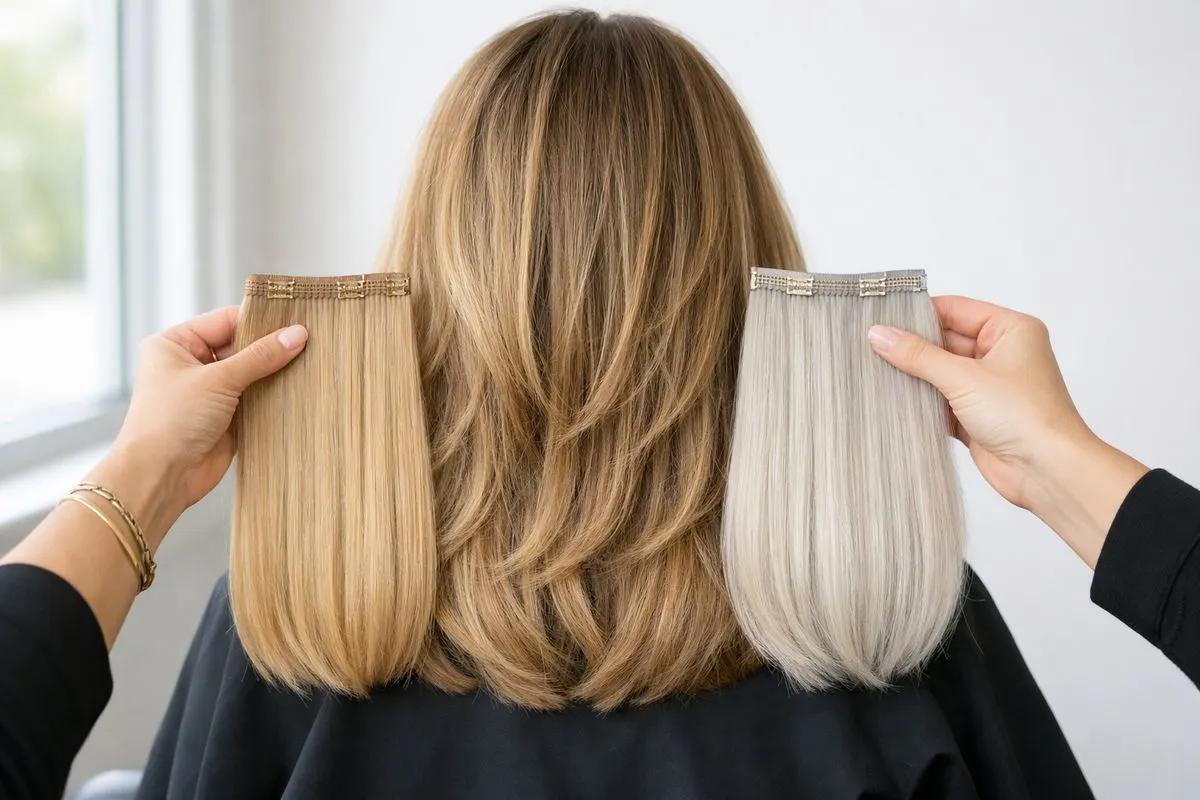
Extensions blend into the body of the hair, which means the visible reference point is the mid-length and end area. That matters for anyone with balayage, faded toner, a toner being a gloss that adjusts unwanted warmth, brassy bands, box-dye history, or an uneven result from another salon. A root-only match often creates a sharp visual break once the hair falls into place.
The most natural result comes from reading the whole canvas. If the mids are beige, the ends are slightly warm, and the root is deeper, the extension formula has to respect that pattern.
Undertone decides whether hair shimmers or clashes
Level is only half the match. Undertone decides whether the color melts or fights.
Hair can be warm, neutral, cool, golden, beige, ashy, copper, or red, even when two shades appear equally dark or equally blonde on a swatch ring. A level 8 beige blonde and a level 8 ash blonde are not interchangeable. One softens into warmth. The other can read smoky or green against the wrong base.
This is where many extension purchases fail online. Screens distort warmth. Product photos oversimplify dimension. One customer review even described a supposed copper match turning fluorescent orange, which says plenty about trusting photos over real assessment.
Why dimensional color often needs more than one shade
Real hair is rarely one flat color, especially after balayage, highlights, lowlights, or corrective toning. Natural-looking results usually come from mixing shades rather than forcing one uniform match.
That multi-tonal approach helps blur the visual edge between natural hair and extension hair. It recreates the irregularity that actual hair has: slightly deeper pieces underneath, brighter ribbons near the face, softer ends, shadow near the base. In other words, it looks alive.
For clients focused on fullness more than length, shade mixing matters just as much. Density reads more natural when the added hair reflects light the same way the natural hair does, which is why many shoppers benefit from learning what really blends for fullness before chasing extra inches.
Texture tells the truth before color does
Texture often gives extensions away before color does. A close shade match cannot save hair that moves, swells, or reflects light like a separate material.
Straight hair needs straight hair. Loose waves need a similar bend. Curly and coily patterns need extension hair that mimics their pattern instead of resisting it. In Hampton Roads humidity, mismatched texture gets louder by the hour because the natural hair expands while the extension pattern stays frozen.
Straight, wavy, curly, and coily: matching the pattern
Curl pattern is not a decorative detail. It is structure.
Straight extensions in wavy hair create a visible split between top and bottom sections. Loose body-wave extensions in tighter curls create a frayed, stretched look. Textured and curly clients need hair that shrinks, lifts, and separates in a way that matches their own pattern. Industry reporting also notes rising demand for diverse textures, which reflects a better understanding of what actual blending requires.
A believable blend depends on behavior, not just curl shape on day one. The extension hair has to respond to moisture, styling, and movement in a familiar way.
Shine, porosity, and finish matter too
Porosity changes how hair looks and feels. Porosity means how easily hair absorbs and loses moisture. High-porosity blonde, overprocessed lightening, and box-dye damage often create a rougher surface that diffuses light instead of reflecting it evenly.
That is why texture matching also includes finish. Hair that is too glossy can look plastic against softer natural lengths. Hair that is too sleek can sit strangely beside natural frizz. A successful match accounts for surface shine, puff factor, softness at the ends, and how the hair behaves after a few hours outside.
Density, weight, and proportion: the architecture of a seamless blend
https://www.youtube.com/watch?v=1u9RiSea_5Q
Extensions look fake when the architecture is wrong. Too much hair creates bulk and strain. Too little hair leaves the natural perimeter sitting on top like a thin curtain over a thicker layer.
This is one reason thickening services have become such a major demand driver. A 2026 industry report noted that at least 40% of one salon’s extension clientele came in seeking density rather than extra length. The goal has shifted from “make it longer” to “make it belong.”
Fine hair needs lightweight strategy
Fine hair needs restraint. Lightweight grams, flatter methods, and even distribution keep the install from exposing itself.
Bulky attachment points show fast on finer density because there is less natural hair to hide them. Heavy installs also place more tension on hair that already lacks internal support. Natural-looking work starts with respecting what the hair can safely carry, not what a trend page is pushing that month.
Thick hair needs enough hair to avoid the shelf line
Thicker hair has the opposite problem. If the extension density is too light, the wearer’s own ends sit bluntly over a thinner layer beneath, creating the classic shelf line.
That line is especially visible on one-length cuts or grown-out bobs. Thick natural hair often needs more rows, more fullness, and more internal layering so the shape transitions gradually instead of dropping off in a hard ledge.
Thickening vs lengthening: buying for the real goal
Buying for the wrong goal leads to bad decisions. Someone seeking fullness should not be sold a length-first plan that leaves the hair stringy at the bottom. Someone seeking length should not be overloaded at the root just to create unnecessary drama.
A useful consultation separates three goals: thickening, lengthening, or both. That distinction shapes grams, method, placement, and the final haircut. It also shapes pricing, which varies widely based on hair amount, method, and customization. For anyone comparing options, what changes the quote is usually more revealing than the number itself.
Methods that blend best by hair type and lifestyle
The best extension method is the one that disappears into real life. That means the method has to suit the hair type, daily habits, maintenance tolerance, and styling routine, not just the desired after photo.
Clip-ins, halo, and other temporary options
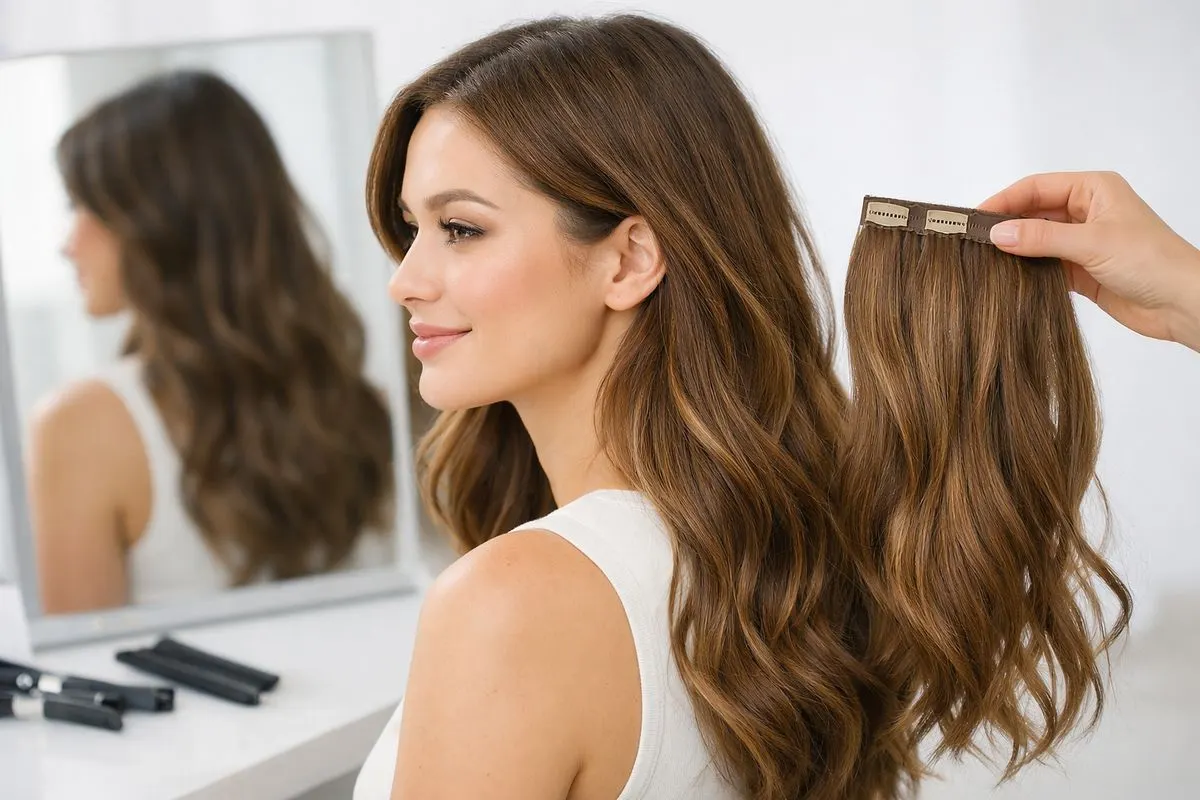
Temporary options suit occasional wear, event styling, first-time extension users, and anyone who wants commitment-free fullness. Clip-ins can work beautifully when the hair has enough density to hide the clips and enough length to mask the transition. Halo systems sit flatter and avoid attachment stress at individual points, which is one reason they are often described as especially easy to blend.
The limitation is structure. Very fine hair, very blunt cuts, or very short lengths expose temporary pieces faster. These methods can look natural, but they rely heavily on styling and strategic placement.
Tape-ins, hand-tied, keratin, and sewn methods
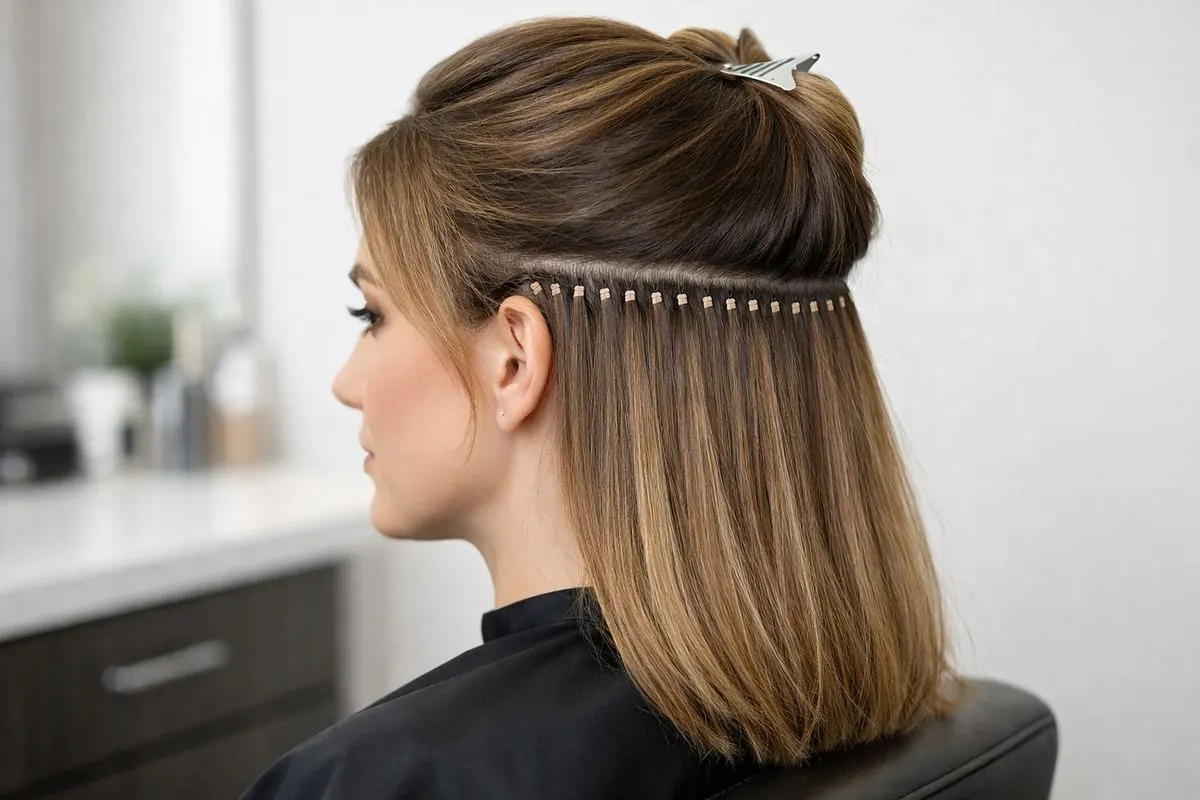
Semi-permanent methods bring more consistency because they stay in place and become part of the haircut. Tape-ins usually lay flat and feel light when installed properly. Hand-tied and sewn methods can create beautiful fullness, though they need enough natural coverage and careful weight balance. Keratin bonds allow flexible placement and strong movement because the attachment is smaller and more individualized.
Each method becomes obvious when it is used on the wrong hair. Tape-ins can flash on sparse hairlines. Wefts can create bulk on fine density. Keratin can feel too ambitious for hair that is already compromised. For clients comparing the two most common low-profile choices, how these methods differ visually often becomes the deciding factor.
Hybrid installs and Nano/Flat attachment trends
Hybrid installs are becoming popular for a reason. They solve problems that single-method installs often cannot.
A client with finer temple areas, denser back sections, and a short blunt perimeter may need different solutions on different parts of the head. Smaller, flatter attachment points and nano-sized systems support that customization. Industry coverage describes modern extensions as smaller and flatter, which improves comfort and invisibility while reducing unnecessary stress.
Placement is where good extensions become invisible
Placement is where technical skill stops being abstract. Premium hair still looks obvious when it is installed too high, too close to the hairline, or without enough natural coverage above it.
Why the crown and hairline expose everything
The crown, part line, temples, and nape are danger zones. These are the areas where wind parts the hair, daylight hits directly, and natural density shifts.
Stylists leave strategic natural hair above the install because that top veil hides attachment points when the hair moves. Place extensions too close to the crown, and they start to announce themselves every time the head tilts forward. Place them too close to the hairline, and the edge reveals itself before noon.
The “sandwich” effect for short or blunt haircuts
Short or blunt cuts need more engineering. The “sandwich” technique places natural hair above and below the extension so the added hair stays wrapped inside the wearer’s own shape.
This matters because a blunt perimeter gives no forgiveness. One row is easier to spot. One dense ledge gives the whole install away. Sources consistently recommend sandwich placement and more layering for short hair because concealment depends on depth, not just coverage.
Staggering rows for movement and concealment
Staggered placement prevents ridges and spreads out weight. It also helps the hair swing as one body instead of separating into visible shelves.
Good installs do not stack like shelves in a cabinet. They arc, shift, and adjust to the head shape. That hidden geometry is one of the quiet reasons a result looks expensive even before the color is discussed.
The cut after the install: where the blend is actually finished
The blend is not finished when the hair is attached. It is finished when the shears start whispering through the last dry inches and the shape finally stops looking borrowed.
Extension hair fresh from the package has its own density line, its own perimeter, its own intention. A believable result only appears after that raw material is cut into the wearer’s haircut.
Layering removes the “extension shelf”
Layers erase the hard transition between natural length and added length. Without them, many installs carry a blunt ledge where the natural hair runs out and the extension body continues.
Soft layers break that line. They create taper, air, and a more organic fall. That single change often separates “obvious extensions” from hair that simply looks fuller.
Point cutting and face framing create movement
Point cutting softens the perimeter by snipping into the ends instead of across them. Face framing makes the front match the rest of the haircut rather than hanging as two heavier side panels.
These details matter because people see the front first. If the face area looks too dense, too uniform, or too disconnected from the haircut, the illusion fails immediately.
Why extensions should be trimmed while worn
Extensions reveal their true drop only on the head. That is when the stylist can see density, movement, shrinkage, and how the natural hair sits over the install.
Trim first on a table, and the result stays generic. Trim while worn, and the result becomes specific. That is where realism lives.
Styling is the final merge
Styling is the final merge because natural hair and extension hair have to be finished together, not side by side. If one section is polished and the other section is textured, the separation becomes obvious even with a strong color match.
Curling or straightening together for one pattern
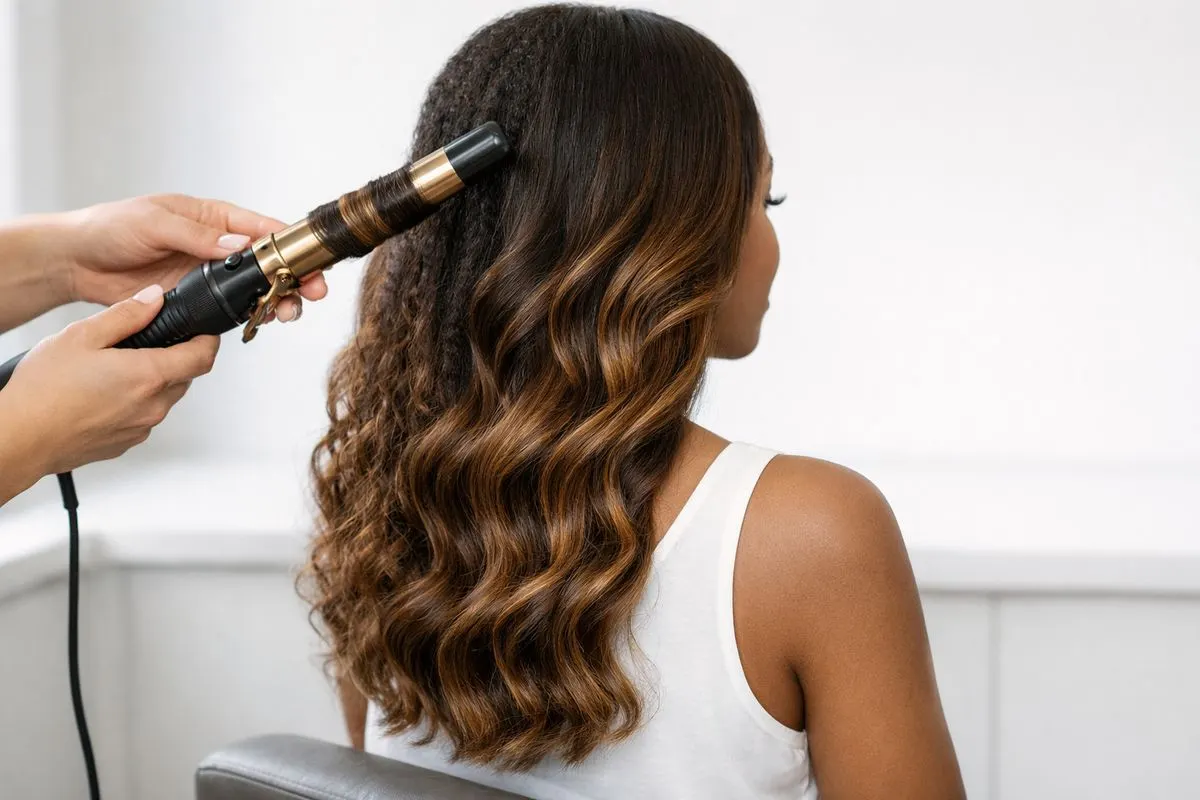
Natural hair and extensions should be curled or straightened together using the same tool size, direction, and tension. That shared pattern hides the handoff point between one and the other.
This matters even more for wavy and curly blends. Sources repeatedly recommend curling together because movement blurs where natural hair ends and extension hair begins. Separate styling creates separate identities.
Humidity, wind, and coastal weather in the 757
Coastal weather punishes fake-looking installs. Ocean air lifts frizz, heat softens bends, and wind opens the crown at the worst possible moment.
That is why buyers in Virginia Beach and the wider Hampton Roads area should prioritize textures and methods that hold up outside the salon. A sleek finish that only survives under still indoor air is not a natural finish. Realism has to survive the parking lot.
Human hair quality, processing, and what buyers should ask
Not all human hair behaves the same. “Human hair” is a category label, not a quality promise.
Natural-looking results depend on cuticle alignment, processing standards, softness after washing, and how the hair responds to heat over time. Lower-grade hair often looks decent on day one and rough by wash three.
Remy hair, cuticle direction, and longevity
Remy hair means the cuticles are aligned in the same direction. In practical terms, that reduces tangling, keeps the surface smoother, and helps the hair move more like natural hair.
The market continues to lean hard toward premium human-hair demand because shoppers recognize the difference in durability and finish. That preference is not hype. It is visible in the mirror.
Bond-preserving processing and why it matters
Processing affects the internal strength of the hair fiber. Bond-preserving processing aims to protect the inner structure, especially the disulfide bonds that help keep hair stable and elastic.
When that structure is better preserved, the extension hair stays softer, bends more naturally, and resists the dry, frazzled look that makes installs obvious. New manufacturing claims around bond-preserving processing reflect the category’s push toward realism that lasts beyond the first week.
Red flags that signal lower-quality hair
A coating-heavy shine is a warning sign. So are stiff ends, rapid matting, uneven density, and hair that looks smooth in the package but frays after a couple of washes.
Poor-quality hair also tends to shed more, knot faster, and lose softness unevenly. Those changes destroy the blend because texture and reflectivity stop matching the natural hair. The install starts out polished and ends up visibly tired.
Common buying mistakes that ruin the blend
Most bad extension experiences start before installation. They start with the wrong decision framework.
Choosing method before assessing hair condition
The hair condition comes first. Damaged blonding, breakage, box-dye history, and compromised ends should shape the entire plan.
An honest stylist does not promise instant drama to hair that is already overworked. For many clients considering balayage, color correction, or keratin extensions at Eugenia’s Hair Studio, the safest path is a staged one. That honesty protects both the result and the hair underneath it.
Buying for drama instead of proportion
Too long, too dark, too bright, too dense, too thick, too abrupt. Drama reads fast, but it rarely reads natural.
Believable enhancement wins because proportion is what makes hair look expensive. A few inches that suit the haircut, density that matches the perimeter, and color that echoes the existing tone look polished long after shock value fades.
Ignoring maintenance, move-ups, and daily wear habits
Neglected aftercare turns even a beautiful install visible. Brushing matters. Sleeping habits matter. Workout routines matter. Heat protection matters.
Maintenance appointments matter too. Extensions shift as hair grows, and attachment points that started hidden do not stay hidden forever. The best install in the room still needs upkeep to stay soft, secure, and discreet.
Best choices by real-life scenario
The right extension plan changes with the hair in front of the mirror. There is no one-size-fits-all formula, only a better match between goal, condition, texture, and daily life.
For fine or thinning hair
Lightweight, low-tension, discreet methods make the most sense. Thickening usually looks better than chasing dramatic length because proportion stays believable and the natural hair can support the result more safely.
Smaller attachments and careful density matching matter most here. The goal is softness and coverage, not visible ambition.
For balayage, corrective color, or uneven tones
Dimensional shade blending becomes the priority. Clients with banding, brassiness, faded gloss, or corrective color history need custom tonality that matches the overall picture rather than a single swatch.
This is where consultation matters most. Hair that is already on a correction journey benefits from a plan that respects safe lightening limits, undertone control, and staged changes.
For curly and textured hair
Curl pattern match is non-negotiable. So is shrinkage awareness, humidity behavior, and a finish that preserves the character of the natural hair instead of flattening it to suit the extensions.
Textured installs look most believable when both hair types are styled as one pattern and allowed to behave naturally. Fighting the texture usually exposes the blend.
For first-time extension clients wanting a natural upgrade
A lighter pathway is often the smartest one. Temporary options or smaller installs give first-time clients a chance to learn maintenance, test density, and decide whether they actually want more length, more fullness, or simply better shape.
The best first install rarely chases the biggest transformation. It aims for softness, ease, and hair that nobody can identify as “done.”
The consultation scene: how the right stylist decides what will blend
The strongest extension result begins before any hair is ordered. Daylight hits the chair. Fingers separate sections at the crown. The stylist studies density, porosity, old breakage, color bands, and the way the front falls when the hair is left alone.
That is the real consultation. Not a trend photo and a fast promise, but an honest reading of what the hair can safely handle and what will actually blend. At Eugenia’s Hair Studio, that kind of assessment matters for extension clients and for anyone considering balayage or color correction after a disappointing result from another salon.
A good plan covers color history, lifestyle, maintenance habits, and the finish the client actually wants to live with on an ordinary Tuesday. For anyone ready for that kind of tailored conversation, schedule a consultation and talk with Eugenia about hair goals that make sense in real light.
The most common questions
How can natural-looking hair extensions be spotted most easily?
They are usually spotted at the crown, hairline, and ends. Obvious color breaks, bulky attachment points, and a blunt shelf line are the most common giveaways.
Do natural-looking extensions need an exact color match?
They need the right overall blend, not always one exact flat color. Multi-tonal hair often looks more natural when 2 or more shades are combined to match dimension through the mids and ends.
Which extension method looks the most natural?
The most natural method depends on hair density, texture, haircut, and maintenance habits. Flat, lightweight, well-placed methods usually disappear better than heavier installs placed too high or too densely.
Can extensions look natural on short hair?
Yes, but short hair needs more planning. Short or blunt cuts often require more pieces, careful layering, and sandwich placement so the natural hair hides the transition.
Why do extensions look great at first and then start looking fake?
Poor-quality hair, skipped maintenance, humidity, rough brushing, and untrimmed growth all expose the install over time. A natural look depends on upkeep as much as the original application.
Are extensions a good idea during color correction?
Sometimes yes, sometimes no. Hair that is overprocessed or fragile needs an honest assessment first, and staged work often produces a better result than forcing both correction and installation too fast.When the light hits the glass again, the right extensions do not ask for forgiveness. They simply belong there.